
Researched Learning Strategies
| How students learn to write
Students learn to write by reading models and receiving explicit skill instruction. Not only does reading supply the information that writers need, but reading also develops awareness of what writing is supposed to look like. Writing style is a special kind of language. Unlike speech, writing involves conventions such as spelling, punctuation, the creation of complete sentences, sentence variation and certain expressions and sentence structures heard rarely in speech but seen often in written text (Benjamin, Hugelmeyer 92). Readers may become better readers by reading more, but writers do not become better writers by writing alone. |
  Since language is acquired “from input, not output, from comprehension, not production” (Krashen136), the reason we cannot learn writing by simply writing more makes sense. In order for students to be successful, confident writers, they must read mentor |
|||||
|
||||||
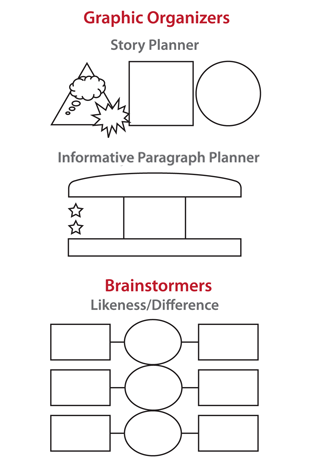 |
Best Teaching Practices using colored sentence shapes teach sentence structuresreading mentor texts planning and brainstorming in graphic organizerswriting daily and daily revision practicescaffolding, guided interactive instructionverbally rehearsingexgaging multiple learning paths with multisensory instructionusing systemic common language, planners and rubricsemploying differentiationspiraling scope and sequence of skillsutilizing muscle movement, memory and learning connectionsthinking critically – compare/contrast, using colored sentence shapes teach sentence structuresreading mentor texts planning and brainstorming in graphic organizerswriting daily and daily revision practicescaffolding, guided interactive instructionverbally rehearsingexgaging multiple learning paths with multisensory instructionusing systemic common language, planners and rubricsemploying differentiationspiraling scope and sequence of skillsutilizing muscle movement, memory and learning connectionsthinking critically – compare/contrast, cause/effect and problem/solution deconstructing and analyzing writing for understanding |
|||||
The Research Behind Using Rubrics |
||||||
|
Andrade, Du and Wang (2008) investigated the effects of having third and fourth graders read an assignment, set goals and use rubrics to self-assess the quality of the written work they produced. A comparison group brainstormed criteria and self-assessed their drafts but did not use the rubric. The group that used the rubrics for self assessment wrote better overall and specifically in the areas of ideas, organization, voice and word choice. |
However, there was no difference in conventions. Andrade, Du and Mycek (2010) duplicated these findings with students in fifth, sixth and seventh grade using a rubric. The rubric group’s writing was evaluated as having higher quality on all six criteria. |
|||||


