How can Writing Alive help your school?
Writing Alive helps teachers manage the task of teaching a diverse group of students to successfully write for a variety of purposes. Our comprehensive curriculum will empower the teachers in your school to effectively teach the writing process, traits of writing, grammar, writing structures, and assessment strategies for a variety of modes and genres.
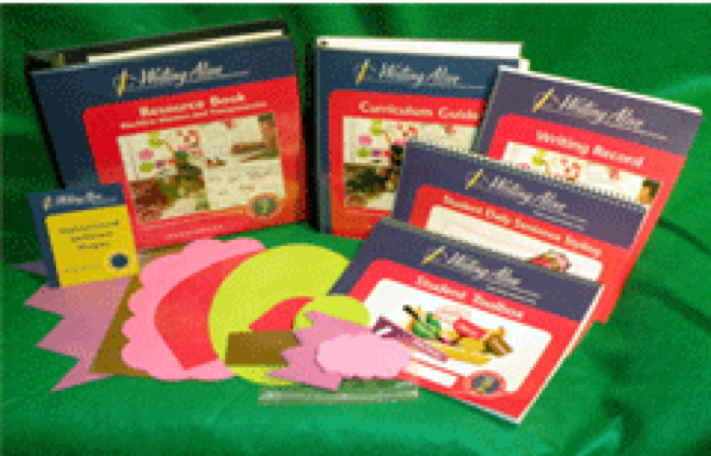 Writing Alive is a comprehensive writing curriculum. Writing Alive is a comprehensive writing curriculum.
Writing Alive integrates all six components of writing into grade level scope and sequenced instruction, ensuring that no gaps in skills or state standards exist. All the materials needed to start immediately are at the teachers fingertips:
Essential Curriculum Kit
The teacher guide, assessment tools, blackline masters, sentence shapes for students and teacher, plus a selection of instructional tools.
Student Books
Daily Sentence Styling Books
Student Toolboxes
Click here to view more information about these materials.
Writing Alive trains teachers in cutting edge writing education through comprehensive staff developments and trainings.
Staff development begins with four days of intensive Writing Alive classes, based on researched learning strategies. Teachers receive three years of Writing Alive implementation support. Each year takes teachers deeper into the curriculum to create master writing teachers. Writing Alive utilizes a coach model to build ongoing school support.
Writing Alive is designed to help English Language Learners and students with special needs.
Writing Alive uses proven learning strategies and a multisensory hands-on approach, which makes it especially effective with English language learners and students with special needs. Teachers deliver instruction using three or more learning channels, so all students receive and retain the information. Students learn structure by manipulating sentence components and gain fluency by verbally rehearsing paragraphs, stories, and essays. As a result, English Language Learners, gifted students, and students with learning challenges (dyslexic, ADHD) succeed and thrive.
Writing Alive is also designed to support your district's current literacy program.
Writing skills and genres covered in Writing Alive match and exceed those in other literacy programs. Writing Alive not only shows what to teach students, it explains how to teach them. Writing Alive's writing curriculum fits hand-in-hand with any reading series, guided reading, math, science, or social studies unit. Students learn to use writing to synthesize their learning to clarify their understanding of the content.
Writing Alive exposes students to a variety of modes and genres in writing.
The well equipped student writer can meet the expectations of any writing exercise with the knowledge they gain through the Writing Alive curriculum. Students gain a working knowledge of these types of writing exercises through a foundation built throughout their school careers. Here are some examples of the different types of writing students learn through the Writing Alive Curriculum:
Handwriting (grades K-1)
Descriptive paragraphs (grades K-6)
Personal narratives (K-6)
Plot summaries (2-6)
Expository paragraphs (2-6)
Note taking (2-6)
Friendly letters (2-6)
Compare/contrast essays (3-6)
Persuasive paragraphs (3-6)
Literary Analysis (4-6)
Business letters (4-6)
Likeness/difference paragraphs (4-6)
 Writing Alive helps teach students how to organize their writing. Writing Alive helps teach students how to organize their writing.
Each type of writing taught through the Writing Alive curriculum comes with a visual planner (also known as a brainstormer or graphic organizer). This helps students to distinguish between the modes and genres of writing taught. More importantly, it helps students develop their content in an organized and thoughtful manner. Click here to see an example of a fifth grade expository paragraph planner.
|
|