How does Writing Alive help teachers?
Writing Alive helps you manage the task of teaching students to write well.
Writing Alive is the only curriculum that integrates instruction of all six components of writing into Monday through Friday writing lessons throughout the school year.
Writing Alive helps you prepare students to write in a variety of modes and genres of writing.
The well-equipped student writer can meet the expectations of any writing exercise with the knowledge they gain through Writing Alive Curriculum. Students learn how to think out, plan and write in various genres, building a foundation they will use throughout their school career.
Scope and Sequence of Genres:
Handwriting (grades K-1)
 Descriptive paragraphs
Personal narratives
Plot summaries
Expository paragraphs
Note taking
Friendly letters
Likeness paragraphs
Difference paragraph
Compare/contrast essays
Persuasive paragraphs
Literary Analysis
Business letters
Descriptive paragraphs
Personal narratives
Plot summaries
Expository paragraphs
Note taking
Friendly letters
Likeness paragraphs
Difference paragraph
Compare/contrast essays
Persuasive paragraphs
Literary Analysis
Business letters
Writing Alive helps you teach the writing traits.
The following traits are taught throughout each week and are assessed with the rubrics at the end of each assignment:
Organization/components
Writing Alive helps students organize their writing with brainstormers and planners
Word Choice
Writing Alive shows how to increase student vocabulary, starting with vivid verbs and specific nouns, then moves to adjectives and figurative language.
Content
Writing Alive teaches how to improve content vocabulary and content of paragraphs and stories.
Voice
Writing Alive teaches how to use word choice and style to convey mood and tone
Fluency
Writing Alive teaches how to improve fluency with phrases, clauses and varied sentence structure
Style
Writing Alive teaches techniques for style and helps students find their style.
 Conventions
Writing Alive teaches hands on techniques for editing. Writng Alive teaches editing and revision during a Daily Sentence Styling activity and implements them in the writing period.
Presentation
Writing Alive provides handwriting curriculum for kindergarten and first grade
Writing Alive helps you teach students how to organize their writing and improve their vocabulary.
Narrative planners help students think about and plan their stories and personal narratives, while expository planners help students organize their thoughts for paragraphs, compositions and essays (informational, likeness, difference, cause and effect and persuasive). These planners help students distinguish the different thought processes of the modes and genres of writing. More importantly, they help students develop their content in an organized and thoughtful manner. Click here to see an example of a third grade expository paragraph planner.
 Writing Alive provides you with the rubrics and instruction to make student growth intentional.
You will learn how to teach goal setting and assessment, hands on revision lessons and techniques for editing. With focused goals and specific objectives, students learn how to write for a purpose and track their progress on bar graphs throughout the year. Click here to view a fifth grade expository paragraph rubric.
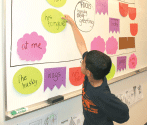 Writing Alive equips you with the materials to teach your students the parts of speech and sentence structures.
Through the use of colorful sentence shapes (i.e. a green apple subjects, purple peaked verbs, red watermelon objects and pink cotton candy clouds for prepositional phrases) students learn how to build a complete sentence from the ground up. Students also use their kinesthetic learning modalities while constructing sentences with the sentence shapes (from simple kindergarten sentences to complex thesis statements) A number of activities and games that help students develop a working knowledge of writing structure.
Writing Alive breaks writing instruction into the steps of the writing process, so students internalize the process.
Students learn how to take a writing assignment from start to completion. Our writing planners help students organize their writing. Rubrics and sentence styling practice help students edit and revise their work, and then take their draft to a final copy. Students complete writing assignments each week.
|
|